
Ask a room of managers whether they care more about people or about results, and almost everyone gives the same answer: both. That answer is sincere, and it is incomplete. The real question is what a leader who values both does on a Thursday afternoon when a customer deadline collides with an exhausted team, when a high performer is also a toxic colleague, or when the budget forces a choice between overtime and quality.
The Leadership Style Assessment, one of the seven Achieving Leader assessments, addresses exactly that question. Grounded in one of the most durable frameworks in organizational psychology, the Blake-Mouton Managerial Grid, it uses a measurement approach designed to surface the trade-offs leaders make when the pressure is on. This article explains the model, why Blake and Mouton argued that one style outperforms the others, how style differs from leadership philosophy, and why the way style is measured matters as much as the model itself.
Free · 2 minutes
Which leadership style leads for you?
Take the Free Leadership Style Quiz: 10 quick questions and your result on screen with no email needed.
What Is the Managerial Grid?
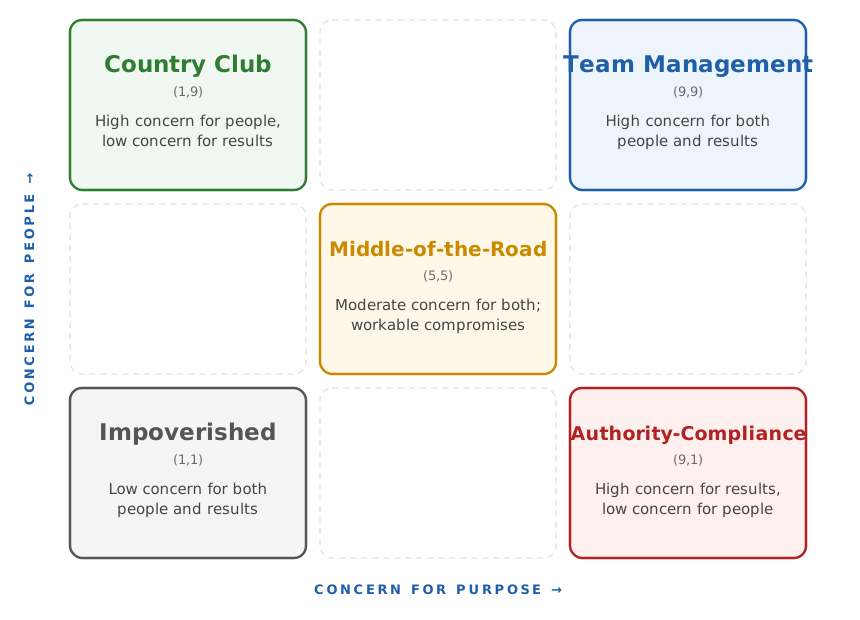
Robert Blake and Jane Mouton introduced the Managerial Grid in 1964. Their core insight was deceptively simple: concern for people and concern for results are two separate dimensions, not opposite ends of a single line. A leader can be high on both, low on both, or high on one and low on the other. Each dimension is scored from 1 (low) to 9 (high), producing a grid of possible leadership orientations (Blake & Mouton, 1964).
That idea did not appear out of nowhere. It built on two major research programs from the 1950s. The Ohio State leadership studies identified two largely independent clusters of leader behavior: consideration (warmth, trust, and respect for subordinates) and initiating structure (defining roles, setting goals, and organizing work) (Fleishman, 1953; Stogdill & Coons, 1957). At roughly the same time, the University of Michigan studies contrasted employee-centered and production-centered supervision (Katz, Maccoby, & Morse, 1950). Blake and Mouton turned these findings into a practical map that managers could use to locate themselves.
Decades later, the underlying dimensions still hold up. A meta-analysis by Judge, Piccolo, and Ilies (2004) found that both consideration and initiating structure have meaningful, independent relationships with leadership outcomes. Consideration was more strongly related to follower satisfaction and motivation, and initiating structure was related to group and organizational performance. The two concerns predict different things, which is precisely why a leader needs both.
The Five Classic Styles
Blake and Mouton described five anchor positions on the grid. Each one reflects a distinct pattern of behavior that most HR leaders will recognize immediately:
- Impoverished Management (1,1): Low concern for both people and results. The leader does the minimum needed to stay employed, avoids conflict, and delegates by default. Teams drift.
- Country Club Management (1,9): High concern for people, low concern for results. The leader prioritizes comfort, harmony, and being liked. Morale may feel pleasant, but accountability erodes and difficult conversations get postponed.
- Authority-Compliance Management (9,1): High concern for results, low concern for people. Sometimes called "produce or perish." The leader treats people as instruments of output, uses control and pressure, and gets short-term compliance at the cost of long-term commitment.
- Middle-of-the-Road Management (5,5): Moderate concern for both. The leader seeks workable compromises: good enough results with acceptable morale. The style feels balanced, but it settles for less on both dimensions.
- Team Management (9,9): High concern for both people and results. The leader builds commitment by connecting people's contributions to shared goals, involves the team in solving problems, and holds high standards with high support.
In later work, Blake and McCanse (1991) added two further patterns: Paternalism, in which a leader swings between controlling and benevolent behavior and rewards loyalty, and Opportunism, in which a leader adopts whatever style serves personal advancement in the moment. These additions acknowledge that real leaders do not always sit neatly at one point on the grid.
The Same Grid, With Modern Names
FactorFactory's Leadership Style Assessment places leaders on this same grid and retires the 1964 labels. "Impoverished" and "Country Club" described what Blake and Mouton saw in the managers of their day; on a report today they read as verdicts, and a leader who sees "Impoverished" next to their name stops listening before the coaching starts. The assessment names each position for the stance it takes: Supporter (1,9), Integrator (9,9), Balancer (5,5), Monitor (1,1) and Driver (9,1). It also calls the results axis concern for purpose, because what a leader is driving toward is rarely just output.
No style is scored as universally better. Each has signature strengths and a predictable shadow side, and the report describes both, along with a backup style: the position a leader falls back to under stress or ambiguity, which is often the more revealing of the two. The assessment is 12 leadership situations in a forced-choice format, takes about 20 minutes, and costs $19.95. If you want a quick read on your own lead style first, the free Leadership Style Quiz takes about two minutes.
Why Does Team Leadership Beat Compromise?
The most counterintuitive claim in the Blake-Mouton model, and the one with the greatest practical consequence, is that the middle of the grid is not the safe choice. Many experienced managers instinctively gravitate to 5,5. It feels mature and pragmatic: give a little here, take a little there, and keep everyone reasonably satisfied. Blake and Mouton argued that this instinct rests on a flawed assumption, namely that people and results are fundamentally in conflict, so the best a leader can do is split the difference (Blake & Mouton, 1982).
Team Management rejects that assumption. A 9,9 leader does not ask, "How much performance should I trade for morale?" Instead, the leader asks, "How do I design the work so that people's engagement is the engine of performance?" Practically, that means setting clear and demanding goals, involving the people closest to the work in deciding how to reach them, confronting conflict openly rather than smoothing it over, and treating mistakes as information rather than as grounds for blame. Blake and Mouton (1982) tested the claim directly against situational approaches and reported that managers overwhelmingly selected 9,9 behaviors as most effective across a wide range of scenarios, while recognizing that the specific actions would vary with context.
The broader research literature supports the logic, even where it uses different labels. The Judge et al. (2004) meta-analysis shows that consideration and structure each contribute something unique, so giving up part of either one carries a cost. Work on psychological safety points the same direction: teams learn and perform best when high standards coexist with psychological safety, rather than when leaders choose one over the other (Edmondson, 1999, 2019). Compromise leaves value on the table on both dimensions at once.
None of this means 9,9 leadership is easy, or that a leader should behave identically in every situation. A crisis on the plant floor calls for faster, more directive action than a strategic planning session. The point is that the underlying orientation, high concern for both, should stay constant even as specific tactics flex. A leader who drops to 9,1 every time pressure rises is not adapting to the situation. That leader is revealing a default.
How Is Leadership Style Different From Leadership Philosophy?
The Achieving Leader framework separates leadership style from leadership philosophy, and the distinction matters for development. Philosophy is about beliefs: the assumptions a leader holds about human nature, motivation, and work. The Leadership Philosophy Assessment measures two beliefs from Douglas McGregor's work (McGregor, 1960). Theory Y is the belief that people are inherently motivated and capable of self-direction. Theory X is the belief that people need external control and incentives to perform. The assessment scores the two separately, so a leader can be high on both, low on both, or any mix. For the background, see Theory Y vs. Theory X: The 60-Year-Old Framework That Still Defines Your Management Style.
Style is about behavior: what a leader actually does when allocating attention, making decisions, and responding to pressure. The two are related, but they are not the same. A leader with a strongly Theory Y philosophy may still operate in Country Club mode. That leader trusts people deeply but avoids setting high performance expectations, mistaking trust for permissiveness. Another leader may sincerely believe in people's potential yet slide into Authority-Compliance behavior during quarter-end crunches because no one ever modeled anything else.
Measuring both reveals the gap between intention and action, and that gap is often where coaching becomes most productive. When philosophy and style align at the high end, a leader has a coherent foundation. When they diverge, the conversation shifts from "What kind of leader are you?" to a more useful question: "What gets in the way of acting on what you believe?" The answer might be skill gaps, organizational pressure, role models, or simply a habit that was never examined.
How Does Forced-Choice Measurement Reveal Real Trade-Offs?
A grid model is only as useful as the measurement behind it. Here, many leadership surveys run into a basic problem. If a leader is asked to rate, on a 1-to-5 scale, "I care about my team's well-being" and then "I hold people accountable for results," nearly everyone answers 4 or 5 to both. The items are desirable, the trade-off is invisible, and the result is a crowded cluster of leaders who all appear to be 9,9 on paper. Researchers have long documented this tendency toward socially desirable responding on self-report measures (Paulhus, 1984).
Forced-choice measurement addresses the problem by asking leaders to choose between options that are similarly desirable but reflect different priorities. Instead of rating whether they value people and results, respondents must indicate which response best describes what they would do when both cannot be fully satisfied. For example: protect the team from an unrealistic deadline, or push the team to hit it and debrief afterward. In personality research, meta-analyses show that well-designed forced-choice formats, particularly quasi-ipsative designs, can match or exceed the predictive validity of traditional rating scales while reducing response distortion (Salgado & Táuriz, 2014; Cao & Drasgow, 2019).
The Leadership Style Assessment uses forced-choice items because leadership is largely an exercise in trade-offs, and the format mirrors that reality. The resulting profile shows not just where a leader lands on the grid, but which way that leader tilts when pressure forces a choice. Often that tilt is the most actionable insight in the entire report. With the assessment's own multi-rater option, a coach can compare a leader's self-described trade-offs with how colleagues actually experience that leader's behavior.
From Practice
Consider a composite drawn from consulting work with a family-owned precision manufacturer: roughly 140 employees and about $30 million in revenue. The second-generation owner had promoted a long-tenured plant manager who was universally described as "fair" and "reasonable." Yet on-time delivery had slipped for two years, and the most capable supervisors were quietly leaving for competitors. Exit interviews were polite and vague. The owner suspected a compensation problem.
The plant manager's Leadership Style Assessment results told a different story. His profile sat squarely in Middle-of-the-Road territory, the Balancer style in FactorFactory's report. When forced to choose, he consistently selected options that defused tension. He would split a production target between shifts rather than fix the bottleneck. He would accept a supervisor's partial solution to avoid a hard conversation. He would extend a deadline to keep the peace. His Leadership Philosophy Assessment results, by contrast, were strongly Theory Y. He genuinely believed his people were capable of far more than he was asking of them.
That gap became the center of the coaching work. Observer feedback from the assessment's Multi-Rater Option confirmed the pattern. His supervisors saw him as highly approachable but unclear about expectations and slow to address underperformance. The ambitious supervisors who left, it turned out, had not been chasing money. They wanted a leader who would set a high bar and back them in reaching it. Over the following year, the plant manager practiced specific 9,9 behaviors: co-designing stretch targets with his supervisors, holding weekly problem-solving sessions focused on root causes, and naming performance issues early. On-time delivery recovered, and so did retention among his strongest people. Compensation was never the issue.
If you coach leaders, run a leadership development program, or are preparing first-time managers for larger roles, the Leadership Style Assessment and the other Achieving Leader assessments can help your leaders see where they stand and which trade-offs they make when it counts. Explore FactorFactory's approach to leadership development, or contact FactorFactory to discuss how style, philosophy, and multi-rater data can work together in your organization. Leadership style has its own chapter in my book, The Achieving Leader.
Sources
Research cited in this article, with links to the published work where available.
- Blake, R. R., & Mouton, J. S. (1964). The Managerial Grid. Gulf Publishing.
- Blake, R. R., & Mouton, J. S. (1982). A comparative analysis of situationalism and 9,9 management by principle. Organizational Dynamics, 10(4), 20–43. https://doi.org/10.1016/0090-2616(82)90027-4
- Blake, R. R., & McCanse, A. A. (1991). Leadership Dilemmas: Grid Solutions. Gulf Publishing.
- Cao, M., & Drasgow, F. (2019). Does forcing reduce faking? A meta-analytic review of forced-choice personality measures in high-stakes situations. Journal of Applied Psychology, 104(11), 1347–1368. https://doi.org/10.1037/apl0000414
- Edmondson, A. (1999). Psychological safety and learning behavior in work teams. Administrative Science Quarterly, 44(2), 350–383. https://doi.org/10.2307/2666999
- Edmondson, A. C. (2019). The Fearless Organization: Creating Psychological Safety in the Workplace for Learning, Innovation, and Growth. Wiley.
- Fleishman, E. A. (1953). The description of supervisory behavior. Journal of Applied Psychology, 37(1), 1–6. https://doi.org/10.1037/h0056314
- Judge, T. A., Piccolo, R. F., & Ilies, R. (2004). The forgotten ones? The validity of consideration and initiating structure in leadership research. Journal of Applied Psychology, 89(1), 36–51. https://doi.org/10.1037/0021-9010.89.1.36
- Katz, D., Maccoby, N., & Morse, N. C. (1950). Productivity, Supervision and Morale in an Office Situation. University of Michigan, Institute for Social Research.
- McGregor, D. (1960). The Human Side of Enterprise. McGraw-Hill.
- Paulhus, D. L. (1984). Two-component models of socially desirable responding. Journal of Personality and Social Psychology, 46(3), 598–609. https://doi.org/10.1037/0022-3514.46.3.598
- Salgado, J. F., & Táuriz, G. (2014). The Five-Factor Model, forced-choice personality inventories and performance: A comprehensive meta-analysis of academic and occupational validity studies. European Journal of Work and Organizational Psychology, 23(1), 3–30. https://doi.org/10.1080/1359432X.2012.716198
- Stogdill, R. M., & Coons, A. E. (Eds.). (1957). Leader Behavior: Its Description and Measurement. Ohio State University, Bureau of Business Research.